
Generate Solar Panel Leads with Google Ads (Simple 2026 Guide)
This guide explains, in simple language, how to use Google Ads to generate high-quality solar panel leads. We’ll cover keywords, ad copy, landing pages, budgets, and tracking so you can turn clicks into real enquiries.
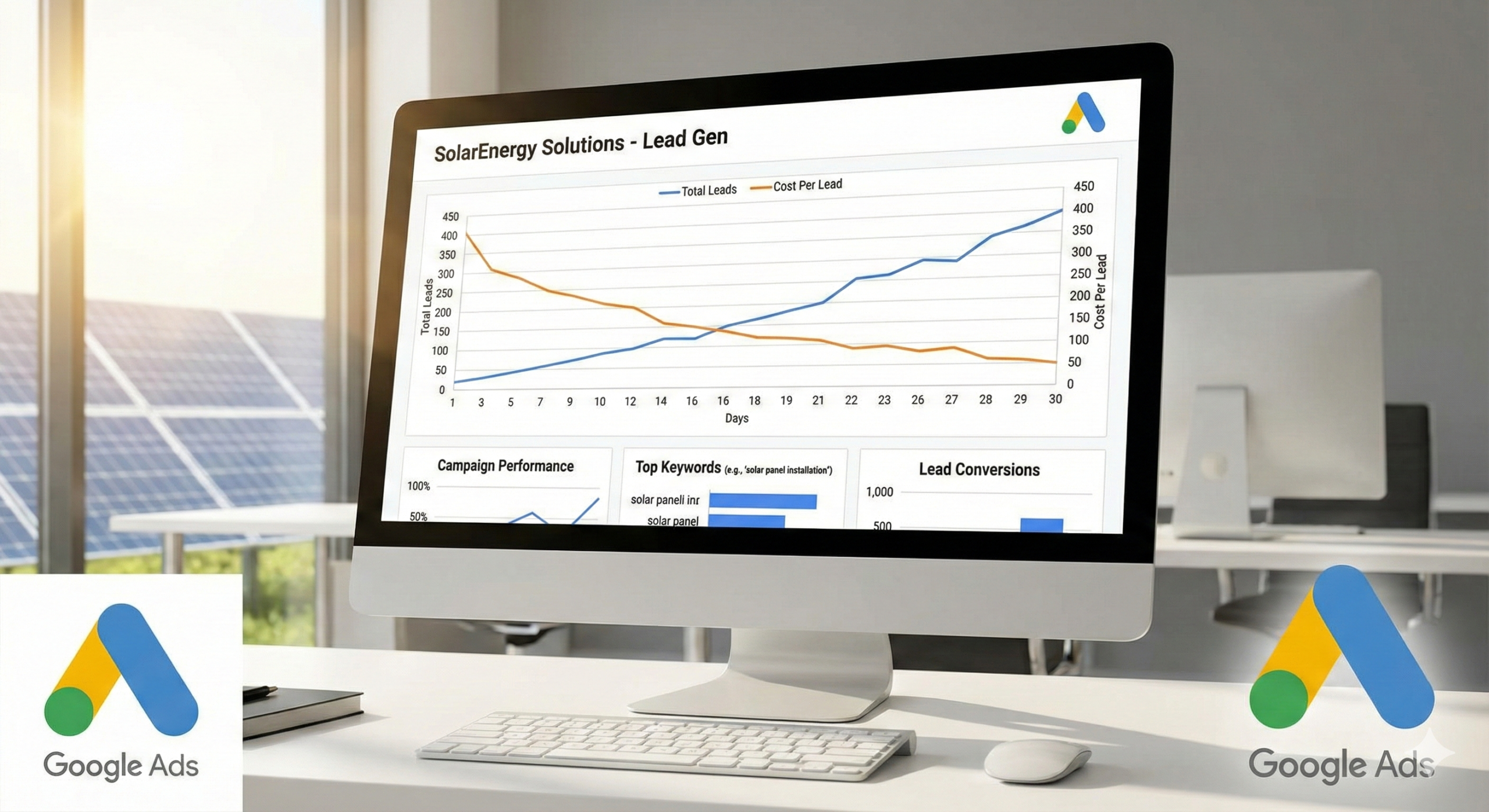
Why Use Google Ads to Get Solar Leads?
When someone searches “solar installation near me” or “solar panel quote in [city]”, they are already interested in buying. This is why Google Ads is so powerful for solar companies — you reach people at the exact moment they are looking for a solution.
Understand the Solar Lead Funnel (TOFU, MOFU, BOFU)
Not every searcher is ready to install solar today. Some are just learning. Others are comparing companies. A few are ready to get a quote now.
Three stages to think about:
For most solar businesses, you should focus your first campaigns on **BOFU** keywords (ready-to-buy users), and then slowly add MOFU and TOFU as you scale.
Pick the Right Solar Keywords
Your keyword list decides who sees your ads. The goal is simple: show ads to people who can actually become paying solar customers — not students, job seekers, or DIY researchers.
Example keyword buckets for a local solar installer
| Bucket | Example Keywords | Goal |
|---|---|---|
| BOFU (High intent) | “solar installation near me”, “solar company [city]”, “solar panel quote [city]” | Get leads now |
| MOFU | “best solar companies in [city]”, “top solar installers [state]” | Build good future pipeline |
| TOFU | “solar panel savings calculator”, “are solar panels worth it in [state]” | Use small, controlled budget |
Start with a **tight list** of 10–25 strong, relevant keywords. You can always expand later based on search term reports.
Build a Clean Campaign Structure
A simple account is easier to manage and gives better data. For most local solar companies, one or two well-structured search campaigns are enough to start.
Suggested structure for a city-based solar business
- Campaign 1 – “Solar – Search – Leads – [City]”
- Ad Group 1: “Solar Installers [City]” (BOFU keywords)
- Ad Group 2: “Solar Companies [City]”
- Ad Group 3: “Solar Quote [City]”
- Campaign 2 – “Solar – Brand – [Brand Name]” (optional)
- Protect your brand searches so competitors don’t take them.
Keep similar keywords grouped together. This makes your ads and landing pages more relevant, which usually lowers cost per click and improves lead quality.
Write Clear, Call-Focused Solar Ads
Your ad should answer: “Why should I contact your solar company instead of another one?”
Simple ad formula that works well:
- Headline 1: Exact service – “Residential Solar Installation in [City]”.
- Headline 2: Main benefit – “Lower Electricity Bills with Expert Solar”.
- Headline 3: Trust or offer – “Certified Local Team | Free Consultation”.
- Description: Who you help, what you offer, and a clear call to action: “We install high-quality solar systems for homes in [City]. Book a free consultation today to check savings and financing options.”
Don’t forget extensions:
- Call extension: Let people tap to call directly from mobile.
- Location extension: Show your service area or office.
- Sitelinks: “Residential Solar”, “Commercial Solar”, “Financing Options”, “Free Consultation”.
Fix the Landing Page: Turn Clicks into Solar Leads
The landing page is where the real work happens. Even a perfect Google Ads campaign will fail if the page is slow, confusing, or doesn’t show trust.
Solar landing page checklist
- Clear headline: “Solar Installation for Homes in [City] – Book a Free Consultation”.
- Short sub-headline: “See how much you can save on your electricity bill.”
- Hero section: One main call-to-action – “Request a Free Solar Quote”.
- Form fields: Name, phone, email, address or ZIP, preferred time to call. Keep it short.
- Proof: Reviews, ratings, logos of certifications, before-after photos.
- Benefits: “Lower bills”, “Warranty”, “Quality panels”, “Professional installation”.
- Mobile-first design: Easy to read and tap on a phone.
Decide Budget, Bidding & Locations
Your budget should match your lead goals and local click costs. Solar is competitive, so cost-per-click can be higher than average.
Basic starting approach:
- Start with a daily budget you’re comfortable with (for many local solar companies, this is **$30–$100/day**).
- Use a **“Maximize conversions”** bid strategy at first, once tracking is working.
- Once you have data, shift to **“Target CPA”** or **“Target ROAS”** if you know your target cost per lead.
- Target only the cities/areas where you actually want to install — don’t go too broad at the start.
Set Up Tracking & Call-Based Leads
You should be able to answer, very clearly: “How many leads did we get from Google Ads this month, and what did they cost?”
Tracking basics for solar businesses
- Install the Google Ads tag and/or use Google Tag Manager.
- Track form submissions as a **primary conversion**.
- Track phone calls:
- Use call extensions with call reporting in Google Ads, and/or
- Use a call tracking tool that forwards to your main number.
- Connect Google Ads with GA4 so you can see the full journey.
Common Mistakes Solar Companies Make in Google Ads
- Running broad, generic keywords like “solar panels” without filters.
- Sending traffic to the home page instead of a focused landing page.
- Not tracking calls, so half the leads are invisible.
- Writing vague ads that look like every other competitor.
- Trying to scale too fast before the base campaign is stable.
How AdShot Media Builds Solar Google Ads That Actually Deliver Leads
At AdShot Media, we manage Google Ads for solar and home-services brands with one clear goal: **more qualified leads, not just more clicks.**
Our solar Google Ads process:
- Audit your current setup (or build from scratch).
- Fix tracking and landing pages so every lead is counted.
- Set up clean search campaigns for your best solar keywords.
- Write clear, benefit-driven ads and call extensions.
- Optimize weekly based on real leads, not vanity metrics.
Want a solar Google Ads system built for real ROI?
We design and manage solar lead campaigns for installers and agencies who want clear numbers and better quality leads.
FAQ: Solar Panel Leads with Google Ads
Can Google Ads work for solar panel leads?
Yes. When you target strong intent keywords, send traffic to a good landing page, and track leads properly, Google Ads can be one of the most reliable channels for solar enquiries.
How much budget do I need to start?
Many local solar companies start with $30–$100 per day. After a few weeks, review your cost per lead and lead quality, then decide whether to scale up or adjust targeting.
Should I use Performance Max for solar?
Performance Max can work well once your basic search campaigns and tracking are stable. Use it as a way to scale what already works, not as a shortcut when nothing is set up correctly.