
Advanced Bidding Strategies in Google Ads (2026 Playbook)
This guide explains advanced bidding in simple language. You’ll learn how each bidding strategy works, when to use it, and how to avoid common mistakes that burn budget.
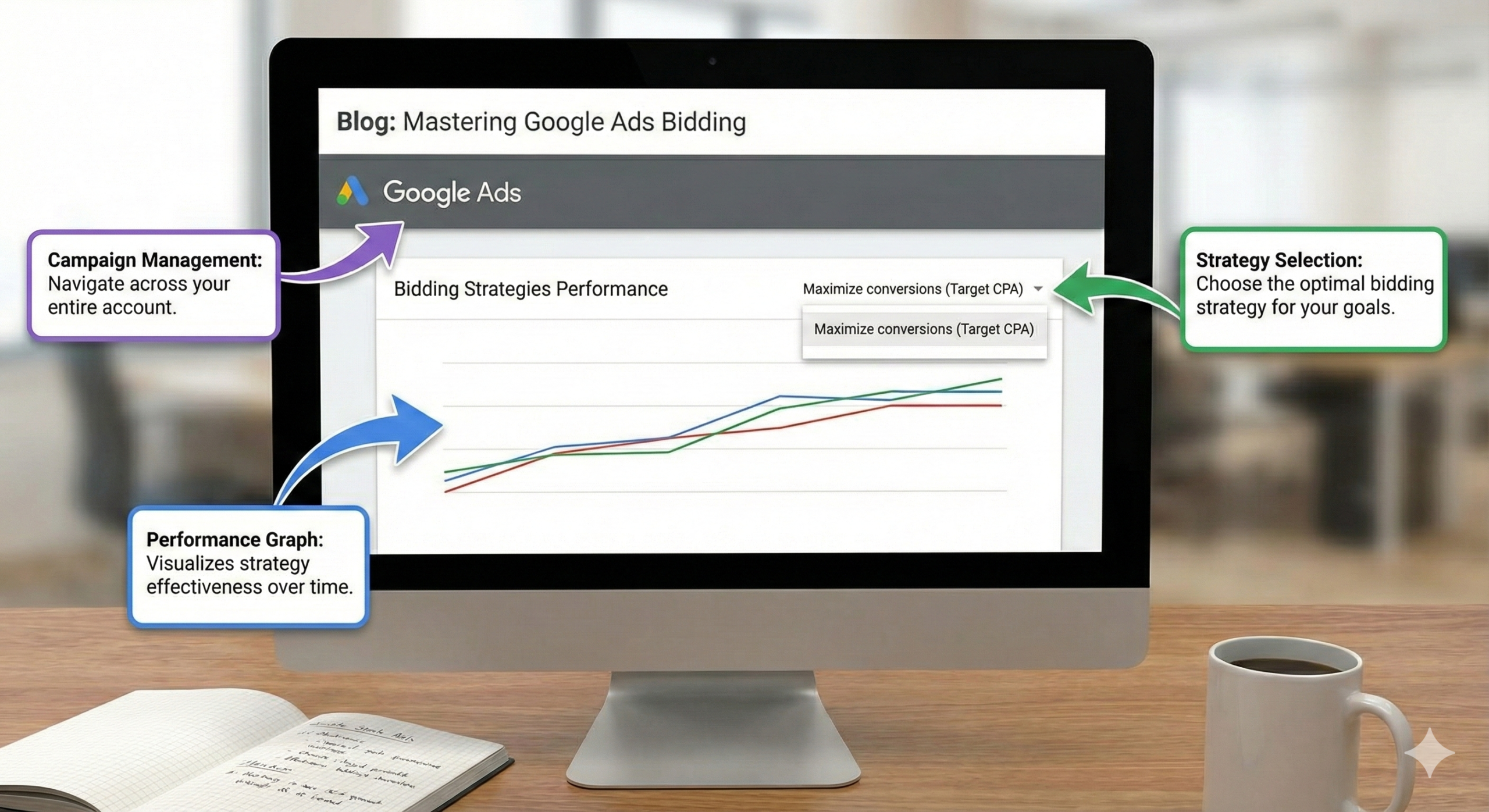
Bidding Basics: What Are You Really Telling Google?
Your bidding strategy tells Google what you care about most: clicks, conversions, or return on ad spend. If you choose the wrong objective, Google will optimize in the wrong direction — and your results will suffer.
A common problem: accounts stuck on “Maximize Clicks” wonder why leads are poor. The bidding strategy is doing exactly what it was told.
Main Bidding Strategies in Google Ads (Explained Simply)
Let’s break down the main bidding options you will actually use in 2026.
| Strategy | What it optimizes | Best for | Notes |
|---|---|---|---|
| Manual CPC | Clicks | Small accounts, testing phases | Full control but no automation. Good to understand baseline CPC. |
| Maximize Clicks | Clicks | Very early testing, awareness | Easy to waste budget if not limited. Avoid long-term. |
| Maximize Conversions | Conversions | Lead gen & small e-com when you don’t know target CPA yet | Great default once tracking is stable. |
| Target CPA | Conversions at a target cost | Lead gen with enough data | Needs 30–50+ conversions / 30 days per campaign or portfolio. |
| Maximize Conversion Value | Revenue/value | E-com or high-ticket with values in place | Focuses on total value, not just count of conversions. |
| Target ROAS | Return on ad spend | E-com & high-ticket with strong data | Very powerful when product feed & tracking are clean. |
How to Choose the Right Bidding Strategy
Instead of asking “Which strategy is best?”, ask: “What is my primary goal right now, and how much data do I have?”
Simple decision path
- Goal: Learn baseline CPC, new niche, low data → Start with Manual CPC or a tightly controlled Maximize Clicks (with a bid limit).
- Goal: Get as many leads/sales as possible at first → Use Maximize Conversions.
- Goal: Keep cost per lead under control → Once you have data, move to Target CPA.
- Goal: Scale revenue, not just leads → Use Maximize Conversion Value or Target ROAS.
Setting Up Smart Bidding the Right Way
Smart Bidding (Google’s automated bidding) can be incredibly effective — if your inputs are clean. If your tracking or structure is messy, Smart Bidding will simply optimize towards bad signals.
Smart Bidding checklist before you switch
- Accurate conversion tracking: No double-counting, no broken tags.
- Primary conversion selected: Use real business actions (leads, purchases), not soft metrics like page views.
- Enough data: Aim for 30–50+ conversions in the last 30 days.
- Clean campaign structure: Don’t mix unrelated countries, budgets, or goals into one campaign.
Remember: Smart Bidding is not magic. It’s pattern recognition based on the data you give it.
Bid Limits, Floors & Portfolio Strategies
Once you move into advanced bidding, you may want to set guardrails so the algorithm doesn’t bid too high or too low in certain auctions.
When bid limits make sense
- You have a clear idea of your maximum profitable CPC.
- You’re in a very competitive niche and want to avoid wild bid spikes.
- You’re moving from Manual CPC to Smart Bidding and want a soft landing.
Portfolio strategies
Instead of optimizing each campaign separately, you can group similar campaigns into a portfolio with a shared Target CPA or Target ROAS. This works well when:
- Multiple campaigns have the same business goal.
- They have similar conversion values or target CPL.
- You want Google to learn across more data instead of small isolated pockets.
Testing & Improving Your Bidding Strategy
Bidding is not “set and forget”. You should test, review, and adjust based on real numbers, not feelings.
Simple testing framework
- Start with a baseline: e.g., Maximize Conversions.
- Run for 2–4 weeks: Let the learning phase finish.
- Check key metrics: cost per conversion, conversion rate, ROAS, volume.
- Test a change: e.g., move to Target CPA with a realistic target (close to your actual average CPA).
- Compare periods: Always compare to similar time ranges and avoid judging too early.
Common Bidding Mistakes That Kill Performance
- Switching strategies too often: Restarting the learning phase every week.
- Setting unrealistic targets: For example, forcing a Target CPA far below your actual baseline.
- Optimizing on bad conversions: Tracking low-quality actions (like page views) as conversions.
- Ignoring lead quality: Lower CPA does not always mean better revenue if lead quality drops.
- Running everything in one campaign: Mixed countries, mixed goals, mixed products.
The AdShot Media Bidding Framework
At AdShot Media, we don’t chase low CPC. We engineer bidding strategies to improve profit per conversion, not just vanity metrics.
Our approach to advanced bidding
- Audit & baseline: Understand your current CPA/ROAS and where money is being wasted.
- Fix tracking: Clean conversions, correct values, remove fake signals.
- Structure campaigns: Separate by geography, product/service, and intent.
- Choose the right bidding mode: Start with Maximize Conversions, then evolve towards Target CPA / Target ROAS as data grows.
- Monitor quality, not just numbers: Tie campaigns back to CRM or real revenue wherever possible.
Want your bidding strategy handled like a pro?
We manage Google Ads budgets for travel, solar, e-commerce, and high-ticket services, using advanced bidding frameworks that focus on ROI.
FAQ: Advanced Bidding in Google Ads
What is the best bidding strategy in Google Ads?
The best strategy depends on your goal and data. For most lead-gen accounts, Maximize Conversions is a strong starting point, and Target CPA is a good next step once you have enough conversions and a clear target cost per lead. For e-commerce and high-ticket sales with proper revenue tracking, Target ROAS is usually the most powerful.
When should I switch from Manual CPC to Smart Bidding?
Switch once tracking is accurate, your campaigns are structured, and you have a stable flow of conversions. If you move too early, Smart Bidding will optimize based on noisy or weak data and results may be inconsistent.
How long should I wait before judging a new bidding strategy?
Give it at least 2–3 weeks and enough conversions to exit the learning phase. Avoid making decisions based on just a few days of performance, especially in low-volume accounts.