

Why This UK Furniture Brand's Google Ads Weren't Converting — And How We Fixed It
Ever spent 30 minutes scrolling Netflix and watched nothing? That is exactly why this furniture campaign wasn't converting. A UK-based furniture brand came to AdShot Media with a simple but critical problem: "We're not getting sales." Here is exactly what we found and what we changed.
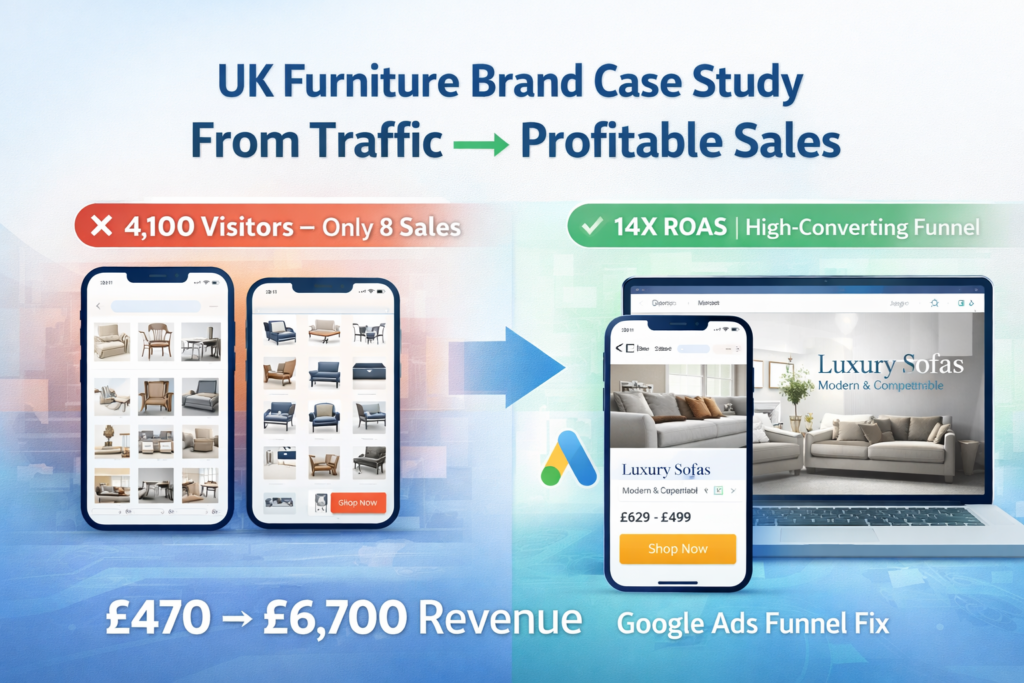
The Problem: Google Ads Spend With No Sales
The furniture brand's request was simple: "We're spending on Google Ads but not getting sales."
Their account was active. Impressions were healthy. Clicks were coming in. But the conversion rate was near zero. This is one of the most common situations in e-commerce Google Ads — the campaign looks like it's working based on surface metrics, but the money isn't translating into actual purchases.
The three questions we always investigate first
- 1️⃣ What is the client's stated challenge — and is there a deeper problem underneath it?
- 2️⃣ How is the campaign setup and structured — are the keywords, match types, and bid strategies aligned with real buying intent?
- 3️⃣ What is the website or landing page experience — does the user's journey from ad to purchase make sense?
AdShot Media's 3-Point E-Commerce Google Ads Audit
Whenever we audit a struggling e-commerce campaign, we apply the same framework — inspecting the campaign structure, keyword intent, and post-click experience simultaneously. Most agencies fix one and ignore the others. All three need to be aligned for a campaign to convert.
What most agencies check
- Bids and CPC
- CTR and impressions
- Campaign budget
What AdShot Media checks
- Keyword intent vs. search term reality
- Campaign structure vs. buying journey
- Landing page experience vs. ad promise
- Conversion tracking accuracy
What We Found in Their Campaigns
Three specific problems emerged within the first 20 minutes of the audit. Each one was quietly destroying conversion potential.
Finding 1 — PMax Only, No Search Campaigns
The brand was running Performance Max campaigns exclusively. PMax is powerful for scale but gives you almost no visibility into which search terms are driving traffic. Without Search campaigns to capture specific high-intent queries ("grey corner sofa UK," "solid oak dining table"), the account was flying blind.
Finding 2 — Irrelevant Search Terms
When we checked the PMax "search terms" insights, the terms were irrelevant — the client's exact words: "Not relatable." PMax was finding traffic, but not furniture buyers. It was showing ads to people searching for interior design inspiration, furniture repair services, and flat-pack assembly help.
Finding 3 — Traffic Sent to a "Shop All" Page
Every campaign sent users to a product listing page with 40+ items. A sofa ad led to a page full of sofas, wardrobes, dining tables, coffee tables, and rugs. The user arrived expecting a specific product and found a showroom. This is the core conversion killer in e-commerce advertising.
The "Netflix Effect" on E-Commerce Conversions
Ever spent 30 minutes scrolling Netflix and watched nothing? That phenomenon — decision paralysis caused by too many options — is exactly what was happening on this furniture brand's landing page.
Consumer psychologists Iyengar and Lepper ran a study showing that when grocery store shoppers were offered 24 jam varieties, 3% bought. When offered 6 varieties, 30% bought. Fewer choices → dramatically more purchases. The same principle applies to e-commerce Google Ads landing pages.
Applied to furniture Google Ads
When someone clicks a Google Ad for a "grey corner sofa" and lands on a page with 40 furniture items, cognitive load increases and decision confidence drops. The user doesn't not want the sofa — they don't know how to find it in the noise. The ad brought the right person. The landing page sent them away.
The Fix: Single-Product Journey Campaign Structure
Instead of sending all Google Ads traffic to a generic "shop all" page, we restructured the campaigns around single-product journeys. Each campaign targets one product category. Each ad group targets one product type. Each landing page shows one hero product — or a tightly filtered category of 3–5 related options.
| Old Structure | Restructured (AdShot Media) |
|---|---|
| ❌ PMax → All Products Page (40+ items) | ✅ Search Campaign (Living Room) → Ad Group (Sofas) → Single Sofa LP → 3 Ad Variants |
| ❌ Generic "Shop furniture" keywords | ✅ "grey corner sofa UK" / "solid oak dining table" / "velvet accent chair" (exact + phrase) |
| ❌ PMax only — no visibility into search terms | ✅ Search (BOFU intent) + PMax (scale) — dual campaign structure |
| ❌ No call tracking or conversion filtering | ✅ Purchase + "Add to cart" as dual conversion actions. Primary = Purchase. |
Why This Structure Works for Furniture Google Ads
✅ Hero product focus
Starting with your top 3–5 SKUs (highest margin, best conversion history, strongest visual appeal) means Google's algorithm has clean, concentrated signals to learn from. Instead of optimizing across 200 products with scattered data, it gets 50 purchases on one sofa — and scales from there.
✅ User clarity
When a user searches "velvet dining chair UK" and clicks an ad, they expect to see velvet dining chairs. A landing page showing that one chair — with good photos, a size guide, and a clear "Add to Cart" button — eliminates decision paralysis and gives the algorithm a clear conversion signal to optimize toward.
The scalable framework this creates
- Hero product campaigns generate your first clean conversion data
- Winning keywords from Search campaigns inform PMax asset groups
- PMax uses those learnings to discover new buyers at scale
- New products are added to campaigns only after structure is proven
Budget Distribution Strategy for Furniture Brands
We recommend a specific budget split between Search and PMax for furniture brands — designed to capture existing demand while building scale signals.
Phase 1 (First 30 days)
- 70% budget → Search campaigns (hero products, exact/phrase match)
- 30% budget → PMax (with strong product feed and hero SKU asset groups)
- Goal: generate 30–50 purchase conversions to feed Smart Bidding
Phase 2 (Month 2–3)
- 50% budget → Search (expand to secondary product categories)
- 50% budget → PMax (now seeded with purchase data and audience signals)
- Goal: scale winning combinations, pause non-converters
Key rule: never run PMax alone for furniture
PMax needs data to optimize. Without Search campaigns running alongside it to generate clean conversion signals first, PMax for furniture defaults to broad display and YouTube impressions — driving awareness but not purchases. Search comes first. PMax scales what works.
Results: What Changed After the Restructure
Most furniture accounts see meaningful efficiency gains within 2–4 weeks after a full campaign restructure, as Google's machine learning re-optimises with cleaner intent signals and improved landing page relevance.
What this furniture brand experienced after restructure
- CPC decreased as consolidated ad groups improved Quality Score
- Qualified clicks increased — search terms became relevant to actual products
- Conversion rate improved significantly once traffic matched landing page content
- Overall ROAS improved as wasted spend on irrelevant broad queries was eliminated
"Too many options killed our conversions. With AdShot Media's structured approach, we finally identified our hero products and scaled profitably." — UK Furniture Brand Client
Key Takeaway: Google Ads Campaigns Don't Fail Because of Budget
Google Ads campaigns fail when users face too many choices and don't know what to pick. Clarity in campaign structure is what drives conversions — not guesswork, broader match types, or bigger ad spend.
- 🪑 Start with hero products — your top 3–5 SKUs by margin and conversion potential
- 🖥️ Match every ad to a dedicated landing page — not a "shop all" page
- 🎯 Run Search alongside PMax — Search gives you visibility and intent data
- 📊 Track purchases (primary) and add-to-carts (secondary) — not page views
- 🔁 Review weekly — furniture demand is seasonal and product-specific
FAQ: UK Furniture Google Ads Case Study
Why didn't PMax work for this furniture brand?
PMax alone isn't enough when search terms are irrelevant and users land on broad product pages. PMax needs conversion data to optimize — and without Search campaigns generating clean intent signals first, it defaults to impression-based traffic rather than purchase-based optimization. Structured Search campaigns complement PMax by capturing high-intent traffic and feeding the algorithm real conversion signals.
Should I always send traffic to single-product pages for furniture Google Ads?
For high-ticket furniture (sofas, dining sets, beds over £400), dedicated single-product landing pages consistently outperform broad category pages. For lower-ticket accessories (cushions, candles, small décor under £50), category pages can work if they have clear filtering and a simple purchase path. The test: can a visitor find and purchase the specific item from the ad within 30 seconds? If not, build a dedicated page.
How do I decide on hero products for furniture Google Ads?
Look at your past conversion data (if available), product margin, average order value, and competitive uniqueness. Start with products that have the clearest search intent (specific material + style + size = "solid oak dining table 6-seater UK") and the best visual appeal for image extensions and product listings. Build your first Search campaigns around these 3–5 products before expanding.
Did CPC actually drop in this case study?
Yes. By consolidating ad groups around tightly themed keyword clusters and matching them to relevant product pages, Quality Score improved. Higher Quality Score means lower CPC for the same ad rank. The combination of more relevant keywords, better landing page experience, and improved CTR all contribute to lower CPC over time.
How fast can furniture Google Ads campaigns see results after restructuring?
Most accounts see meaningful efficiency gains within 2–4 weeks after a full restructure, as Google's machine learning re-optimizes with cleaner intent signals and improved landing page relevance. Full ROAS optimization typically takes 60–90 days as Smart Bidding accumulates enough purchase data to make high-confidence bid decisions.
AdShot Media Audits, Rebuilds, and Scales E-Commerce Google Ads — Like Engineers, Not Marketers
Transparent reporting. Conversion-focused structure. Real-time support. We identify your hero products, build the right campaign architecture, and optimize for real ROAS.
© 2026 AdShot Media. All rights reserved.