AI in Google Ads 2026: How Automation Is Making Marketers Lazy (And What to Do Instead)
Automation has taken over digital advertising. But there's a silent problem growing inside every "smart" campaign: most marketers have stopped thinking. AI isn't the enemy. Laziness is.
The Rise of "Set-and-Forget" Advertising
In 2019, advertisers manually optimized keywords, match types, and ad extensions daily. By 2026, Google's algorithms can automatically adjust bids, create dynamic search ads, and rewrite headlines based on conversion data.
Performance Max (PMax), Responsive Search Ads (RSAs), and Smart Bidding have simplified campaign management. But they've also removed visibility and control.
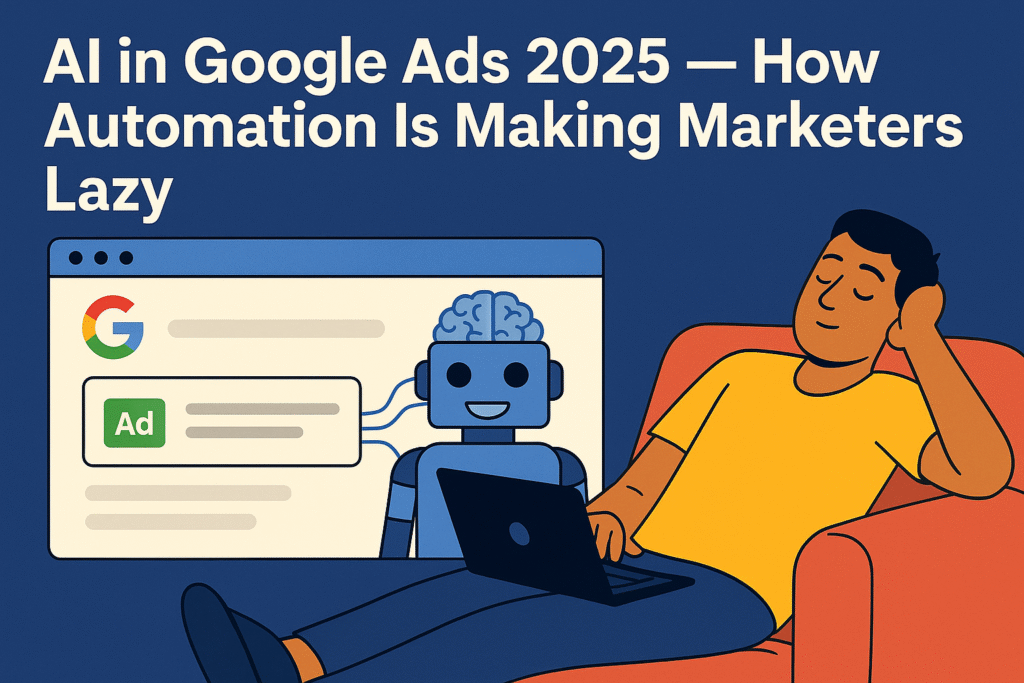
Too many marketers now rely solely on automation reports, without ever checking:
- Which keywords are actually driving calls or purchases?
- Whether the landing page experience supports conversions?
- If Google's AI is bidding for irrelevant search intent?
- Whether Smart Bidding is optimizing toward real buyers or just cheap clicks?
"AI is brilliant at finding data patterns, but terrible at understanding human behavior."
The quiet campaign plateau
The most dangerous performance stage is not a sudden drop — it's a gradual plateau. Smart Bidding keeps optimizing. Impressions stay stable. But CPL quietly rises 3–5% every month because no human is reviewing intent, checking creative quality, or questioning what the algorithm is actually learning.
How Automation Is Creating "Lazy" Marketers
Every automation tool works on feedback loops — data in, data out. When marketers stop manually analyzing results, they feed poor data back into the system. That is when campaigns plateau.
In our agency audits, 8 out of 10 accounts running only Smart Bidding or PMax showed:
❌ What we find in lazy-automated accounts
- Wasted spend on broad, low-intent keywords
- Duplicate targeting across campaigns
- Irrelevant auto-generated ad copy nobody approved
- Zero post-click optimization (no A/B testing)
- No call duration filtering — all calls counted as conversions
- No negative keyword updates in 60+ days
✅ What properly supervised accounts look like
- Weekly search term review — 10–20 new negatives added
- Call duration threshold set (60s+ only as conversions)
- Creative refreshed every 14–21 days
- Conversion tracking audited monthly
- Budget split reviewed by geo and device
- Human sign-off before any budget increases
The result of automation without oversight
Higher CPCs, fewer qualified calls, and poor ROI — not because of Google's AI, but because of how it's being used.
Why AI Needs a Strategist Behind It
AI can process billions of signals, but it cannot understand why people click. It cannot read a homeowner's motivation for searching solar installation at 9 PM. It cannot recognise when a travel query means "holiday research" vs "book now." That is where human strategists come in.
At AdShot Media, we call this balance the "Human-AI Hybrid Framework."
The Human-AI split: what each side handles
| AI Handles | Humans Handle |
|---|---|
| Bids and bid adjustments | Offer strategy and positioning |
| Ad testing and variant distribution | Creative direction and messaging angles |
| Audience clustering and placement | Keyword intent mapping and filtering |
| Budget optimization within campaign | Budget allocation across campaigns |
| Finding new placements at scale | Approving or blocking those placements |
| Spotting conversion patterns | Deciding which conversions actually matter |
"Automation optimizes. Strategy scales."
Case Insight: When Automation Broke a Travel Ads Campaign
In 2026, one of our travel clients approached us after their Performance Max campaigns stopped delivering. Despite high impressions and stable spend, call volume had dropped 40% over 8 weeks.
What we found in the 14-day audit
- Google's automation was pushing 70% of spend toward destination keywords instead of flight booking intent.
- PMax was placing ads on YouTube content about travel vlogs — awareness traffic, not buyers.
- No negative keyword updates had been made in 11 weeks.
- All phone calls (including 8-second hang-ups) were counted as conversions — corrupting Smart Bidding's learning.
What we did — and what changed
| Fix Applied | Before | After (3 weeks) |
|---|---|---|
| Negative keyword restructuring | 0 negatives added in 11 weeks | 247 new negatives |
| Call duration threshold | All calls counted | 60s+ only |
| Campaign intent segmentation | 1 PMax for all travel | Search (BOFU) + PMax (scale) |
| Call volume (qualified) | Baseline (100%) | +62% vs baseline |
| CPC | Baseline | -28% vs baseline |
"The AI was doing exactly what it was told. The problem was nobody was telling it the right thing."
Top 5 Ways AI Is Misused in Google Ads in 2026
These are the five patterns we see most consistently in underperforming automated accounts.
Over-trusting Smart Bidding without checking what it's optimising toward
Smart Bidding maximizes conversions — but your definition of a conversion is what matters. If you're counting page views or 4-second calls as conversions, Smart Bidding will find more of those. Fix your conversion setup before trusting automation with budgets.
Ignoring keyword intent — assuming AI knows the difference between research and buying
Google's algorithm can identify patterns in user behaviour, but it doesn't inherently know that "how does solar work" is a student and "solar installation quote Manchester" is a homeowner. That distinction requires human-defined keyword strategy and negative keyword discipline.
Letting RSAs write all the headlines with no human direction
RSA auto-generated headlines are often generic. "Get the best deal today." "Call us now." "Your trusted partner." These say nothing about your specific offer, differentiation, or target buyer. The algorithm tests combinations — but you decide what goes in.
Skipping the Search Terms report because "AI handles it"
The Search Terms report is where money is won or lost. Important insights remain hidden: irrelevant queries driving spend, competitor brand searches, research intent queries wasting budget. Review it weekly. Add negatives. Always.
Never calibrating conversion tracking — then wondering why results plateau
Google optimises for whatever conversions you feed it — even the wrong ones. Duplicate tags, misconfigured goals, and soft metrics as primary conversions all poison Smart Bidding over time. Monthly conversion audits are non-negotiable.
How AdShot Media Combines AI + Human Strategy
We don't fight automation — we engineer it intelligently. The goal isn't to disable AI. It is to guide it with cleaner signals, better structure, and human oversight.
Step 1: AI-Powered Discovery
Use automation to identify top-performing queries, devices, geos, and times. PMax and Smart Bidding are excellent pattern finders when fed clean data. Let them surface what humans might miss in a large dataset.
Step 2: Human-Led Structuring
Based on AI findings, humans build the structural decisions: campaign segmentation by intent, budget allocation, negative keyword categories, and conversion hierarchy. This is where strategic intelligence separates profitable accounts from average ones.
Step 3: Smart Optimization
Feed AI only with data from real, qualified actions: calls lasting 60+ seconds, CRM-imported closed deals, verified form completions. The cleaner your conversion signal, the more powerful Smart Bidding becomes. Garbage in, garbage out has never been more true.
The compounding advantage
This balance lets AI handle repetitive optimization at scale while strategists stay focused on offer development, creative direction, and growth opportunities the algorithm will never surface. The accounts that use this system consistently outperform fully-automated competitors by 30–45% in qualified lead volume.
The Future of Google Ads: Augmented, Not Automated
In the next phase of digital advertising, the agencies that thrive will be those who combine:
- AI's speed and pattern recognition at scale
- Human judgment on offer, intent, and creative direction
- Real-time dashboards and transparent reporting
- First-party data as the AI's most reliable signal
The agencies that won't survive
- Those who sell "AI-managed campaigns" with no human review
- Those whose reporting hides behind blended ROAS numbers
- Those who stopped doing keyword audits in 2023
"The best Google Ads campaigns in 2026 aren't fully automated — they're intelligently supervised."
Frequently Asked Questions
Is AI making Google Ads better or worse?
Both. For accounts with clean data, clear goals, and human oversight, AI significantly amplifies results. For accounts with weak conversion tracking and no human review, AI amplifies the waste just as efficiently. The platform is neutral — strategy determines the outcome.
Should I turn off Smart Bidding and go back to manual?
Not necessarily. Manual CPC is appropriate early in an account's life (low data) or when you want to learn baseline CPCs. Once you have 30–50 conversions per campaign per month, Smart Bidding with clean conversion data consistently outperforms manual bidding for most advertisers.
What is the biggest AI mistake in Google Ads?
Counting the wrong things as conversions. If Google's AI is optimizing toward page views, soft form completions, or short phone calls, it will find more of those — not more buyers. Set your primary conversion to the highest-value, most specific action in your funnel.
How often should humans review automated campaigns?
Weekly for search terms, negatives, and creative performance. Monthly for conversion tracking accuracy, campaign structure review, and budget allocation. Quarterly for full account audit: bid strategy, attribution model, and audience data quality.
Want Google Ads That Are Intelligently Supervised — Not Just Set and Forgotten?
We combine AI's efficiency with human-level strategic oversight. Clean tracking. Intent-first structure. Weekly reviews. No lazy automation.
© 2026 AdShot Media. All rights reserved.